5 min read
Capability is not a reason
Being able to do more does not tell me which work deserves my time, attention or commitment.
I noticed this most clearly when I became able to run several agents at once. Work that would once have taken me days could continue while I was away from my desk. My list of possible projects expanded almost overnight.
My first response was to fill the new capacity. If a task could now be done cheaply, it felt wasteful to leave it undone. I prepared more work, opened more threads and created more things to review. The queue grew faster than the output.
That exposed a mistake in my reasoning. Capacity answers, 'Can this be done?' It does not answer, 'Does this deserve doing?'
The difference matters because every new capability creates options. Options arrive without their own order. Judgement still has to decide which possibility serves something I value, which cost I am willing to carry and whether now is the right time.
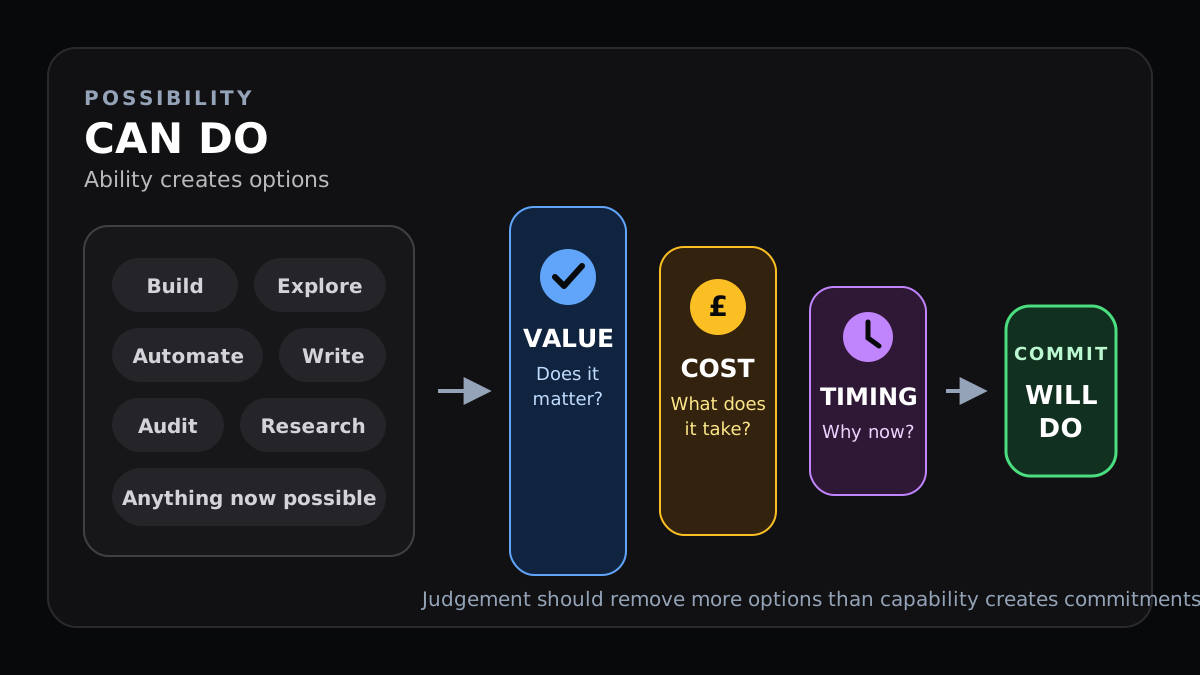
The diagram narrows from left to right for a reason. I should expect the set of things I commit to doing to be much smaller than the set I can do. If the two fields are almost the same size, I am treating ability as permission.
Value comes before ease
Some work becomes tempting because a tool makes it easy. I can generate another version of a page, research another approach or ask an agent to audit an area that is not causing a problem. The low effort makes the activity look sensible.
Ease changes cost. It does not create value.
When I decide whether work matters, I need a reason that exists outside the capability itself. It might solve a real user problem. It might reduce risk. It might support my family. It might teach me something I have deliberately chosen to learn.
'I can get an agent to do it' is not such a reason. It only describes the method.
This distinction has changed how I think about unfinished ideas. An idea can be good, possible and still not deserve a place in the current plan. Rejecting it for now is not a failure to make use of my tools. It is how I protect the work that already has a reason.
Costs move rather than disappear
Automation also makes costs harder to see. A task may need little execution time from me, but it still creates preparation, review and maintenance. If the result affects a product, I need to understand it well enough to accept responsibility for it.
I learned this when I let several pieces of work run in parallel. The agents did not need me for every step, but their results returned together. Each one needed judgement. I had moved the bottleneck from production to review.
That review cost was not shown in the original estimate. Neither was the attention required to remember why each task existed. The work was cheap to start and expensive to absorb.
Cost also includes what the commitment displaces. An hour spent checking an optional improvement cannot also be spent resting, thinking about the product or being with my family. Faster production does not make attention renewable.
Timing can turn good work into bad work
A useful idea can be wrong now. Starting it may divide a product before its main path works. Research may arrive before I have a decision it can inform. A new system may add structure before the existing behaviour is understood.
Timing is therefore a separate filter. Value asks whether the outcome matters. Cost asks what it will take from me. Timing asks whether this moment makes the work more useful than it would be later.
I need all three answers. Strong value does not cancel an unaffordable cost. Low cost does not repair bad timing. Good timing does not make a valueless task worth doing.
What about exploration
A reasonable objection is that capability can reveal value. I sometimes need to try a tool, make a rough version or investigate an idea before I know what it is worth. If I demand a complete case in advance, I may only repeat work I already understand.
That is true, but exploration still needs a boundary. I can give it a question, a budget and a stopping point. 'Spend one hour finding out whether this could remove the manual review step' is an experiment. 'Keep exploring because we can' is an open commitment.
The experiment earns its place by reducing uncertainty. The capability remains the means, not the reason.
A smaller field of commitment
I now want unused capacity to feel normal. It means I have room for new information, problems I could not predict and periods when my energy is lower. It also means I have not converted every possibility into an obligation.
The practical consequence is that a capability list and a work plan must stay separate. One records what is possible. The other records what has passed through value, cost and timing.
Without that separation, better tools will keep producing more commitments. With it, increased capacity can support better judgement instead of replacing it.