5 min read
Indecision is not free
An unresolved choice keeps returning until I close it or defer it with a clear condition.
I noticed this after postponing a small product decision. I did not need to solve it that day, so I left it open. It returned while I was writing, again while I was eating and once more when I was trying to sleep.
The decision had no place in my schedule, but it still occupied attention. I had treated delay as the absence of a choice. In practice, delay created a choice that kept asking to be made.
Indecision can look cautious because it avoids a visible mistake. Its cost is less visible. An unresolved question returns whenever related information appears. I reconsider the same options, recover the same context and feel the same uncertainty without moving closer to closure.
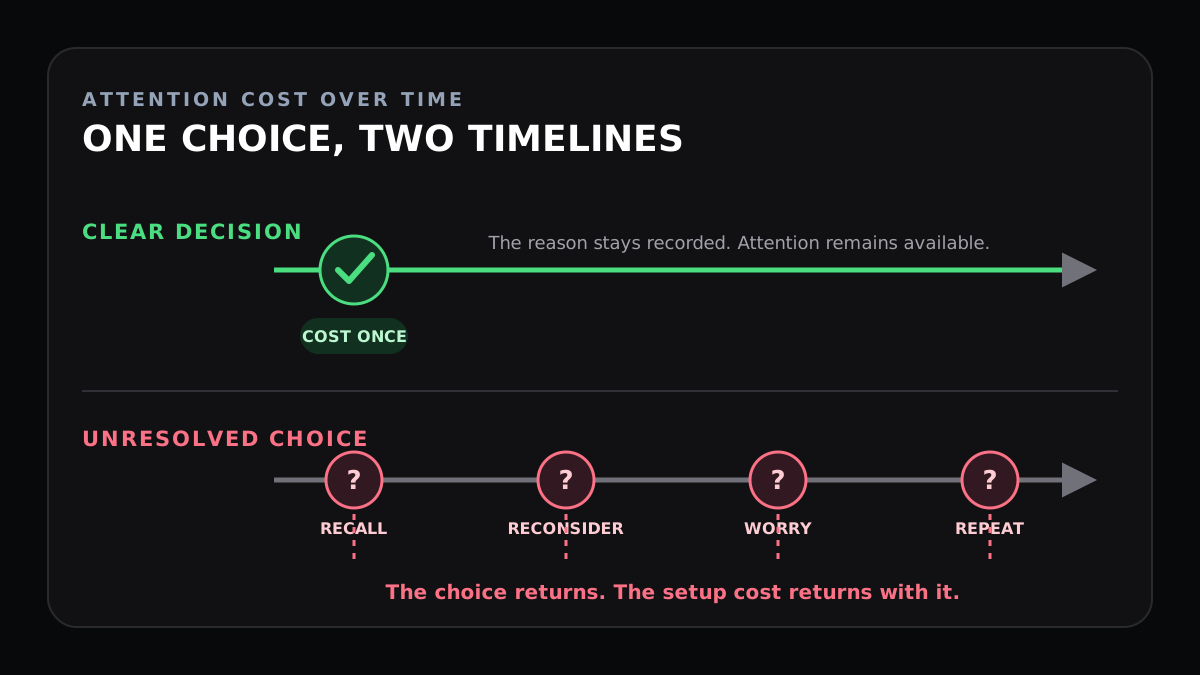
The lower timeline does not show one dramatic failure. It shows repeated small withdrawals. That is why unresolved choices are easy to tolerate. Each return seems cheap. Their total cost only appears when I look across time.
Open choices keep asking for context
A task has a state. It can be ready, in progress, done or deliberately waiting. An undecided task often has no stable state. Each time I see it, I have to work out what it means again.
This happens when I leave vague notes such as 'think about onboarding' or 'maybe change the agent setup'. The words preserve the topic but not the decision. When the note returns, I must rebuild the question before I can act.
I may then reread old material, compare the same options and stop at the same uncertainty. The activity feels like careful consideration. It is often repeated setup.
The emotional cost matters too. An open choice can quietly become evidence that I am behind. It joins every other unfinished thought and makes the whole workload feel larger than the work that is actually ready.
Closure has more than one form
Closing a choice does not always mean picking an option immediately. I can close it in several honest ways.
I can decide and record the reason. I can reject the work. I can defer it to a specific date. I can name the evidence required before it returns. I can also turn a broad decision into a bounded experiment.
The important part is that the current version of the question stops circulating.
For example, 'Should I rebuild this page?' remains open. 'Do not rebuild it before five users complete the current path; review their recordings on Friday' is deferred. It has a condition, a time and a reason not to think about it today.
That kind of deferral protects the decision from my mood. I do not reopen it because the current design annoys me or a new idea feels exciting. It returns when the named information exists.
Record enough to avoid deciding twice
A decision that lives only in my head is easy to reopen. A week later, I remember the outcome but not the reasoning. The missing reason makes the choice look arbitrary.
I do not need a long document for every decision. One sentence can be enough: 'Use the existing article pipeline because it already supports static images and drafts.' That note preserves the constraint that mattered.
For larger choices, I want the options, the evidence and the trigger for review. The goal is not bureaucracy. It is to stop future me paying to reconstruct a decision that present me has already made.
This is especially useful when I work with agents. If I leave a boundary implicit, each new task can question it. If I write the boundary down, the agent can work inside it and report only when new evidence conflicts with it.
What about difficult decisions
A reasonable objection is that pressure to close choices can produce shallow decisions. Some questions need time. A health decision, a major financial commitment or a product direction should not be rushed to clear a task list.
I agree. Speed is not the same as closure.
A difficult choice can enter a deliberate waiting state. I can say what I am waiting for, when I will review it and what I will do meanwhile. If I need a week away from the problem, that week can be part of the decision process.
The danger is unstructured delay. 'Not yet' without a reason or return point leaves the question active every day. Deliberate waiting contains it.
Attention needs closed loops
I cannot prevent thoughts from returning. I can stop giving unresolved choices unlimited permission to return.
That requires a visible decision, rejection or deferral. Each one tells me what the choice means now. It also tells me what new fact would justify reopening it.
The implication is that an undecided item should not remain on an ordinary task list. It needs a decision point or a waiting condition. Otherwise, I keep paying for the appearance of caution without receiving the benefit of a better choice.