5 min read
Freedom needs limits
Chosen boundaries reduce constant choice and make sustained commitment possible.
I noticed that a completely open afternoon rarely felt free. I could work on the product, review an agent, tidy the house, go out with my family or rest. Nothing forced a choice, so I kept checking all the choices.
I would begin one task while wondering whether another would be a better use of the time. Even after choosing, I had not really stopped choosing. Every new message or idea reopened the whole afternoon.
Unlimited options look like freedom from the outside. From inside the day, they can become a demand to keep deciding. A chosen limit removes that demand. It says what this period is for and lets commitment last long enough to become useful.
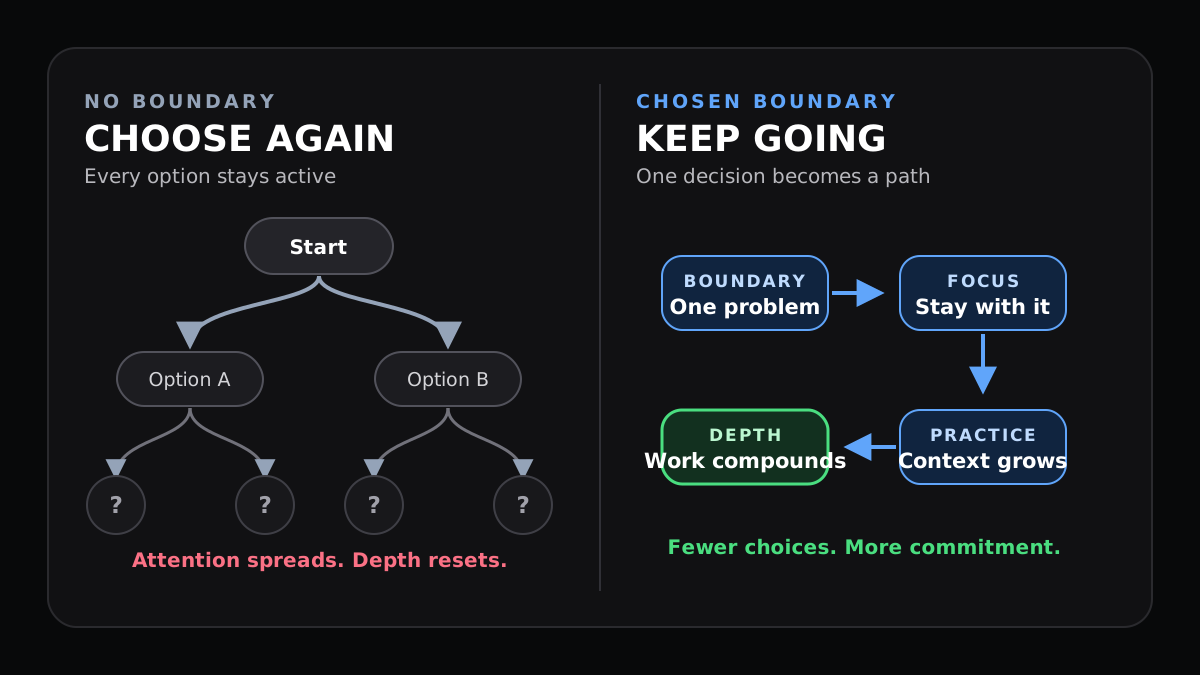
The two sides of the diagram contain the same starting freedom. The difference is what happens after the first choice. On the left, every stage branches again. On the right, a boundary turns the first decision into a path.
Depth needs that path. I cannot get far into difficult work if I keep comparing it with every other possible use of the hour.
Choice has a running cost
I used to think a flexible plan was a plan with more options. In practice, each option remained active in my head. Flexibility became repeated negotiation.
This shows up in small ways. If I let myself choose any task each morning, I can spend the first hour rearranging the list. If every agent can interrupt me at any time, I keep checking their progress. If family time can become work time whenever something interesting happens, I am never fully in either place.
The cost is not only the minutes spent choosing. I also lose continuity. The work feels new each time I return because I have dropped the context that made the next step obvious.
A limit pays that cost once. I decide that a 4-hour block belongs to one problem. I decide that the afternoon belongs to my family unless a real emergency occurs. I decide that new thoughts go to an inbox instead of becoming immediate work.
Those rules remove options from the moment. They do not remove them from my life.
Boundaries make commitment visible
Commitment is difficult when it has no shape. 'Work on the site' can expand into dozens of pages, ideas and technical improvements. 'Use this block to finish and test one article route' gives the work an edge.
The edge matters because it tells me both where to continue and where to stop. Without it, I can abandon the task too early or keep extending it long after my judgement has weakened.
I have found the same thing with rest. 'Rest when I feel finished' does not work because there is always another useful task. A fixed stopping time protects rest from the endless argument that one more action would be harmless.
This is why a good boundary is more than restriction. It carries a decision across time. I do not need to recreate the intention every 20 minutes.
Limits should match what matters
Not every boundary helps. A rigid schedule built around the wrong goal can make me efficient at neglecting something important. The limit has to serve a reason.
My current work pattern tries to separate tasks that need my judgement from tasks that can continue without me. I use focused desk time to decide, prepare and review. I let agents handle bounded execution while I am with my family.
That structure is useful because the boundary follows the work. It does not pretend every task needs the same kind of attention. It also makes family time more real. I am not technically present while mentally monitoring six unfinished decisions.
The structure will change as my son grows, my energy changes and the work changes. The purpose should remain easier to recognise than the schedule.
What about flexibility
A reasonable objection is that strict limits can become brittle. Real life does not respect time blocks. A child needs care, a production problem appears or a useful conversation changes the plan.
I do not think a boundary has to deny new facts. It has to resist weak reasons.
An emergency can change the day. New evidence can change a priority. Boredom, novelty or a difficult first 15 minutes should not. The boundary creates a default strong enough that I need an actual reason to cross it.
That is different from treating the schedule as a moral test. If the facts change, I can choose again. What I want to avoid is choosing again when only my mood has changed.
Freedom that can go somewhere
The point of limits is not to reduce the size of my life. It is to stop all parts of life competing in every moment.
I can choose a direction precisely because other directions remain possible later. A bounded work block does not declare that work matters more than family. A protected family afternoon does not declare that the product no longer matters. Each gives one commitment enough room to be true.
Freedom without a boundary keeps presenting itself as a choice. Freedom with a chosen boundary becomes time I can actually inhabit.